Do you wake up during the night and struggle to get back to sleep?
Do you have difficulty going to sleep?
Do you have difficulty waking up?
Before you try a lot of techniques, devices and medications for your sleep, maybe you first need to track your personal sleep cycle over a week or two.
I’ve had the privilege of working with several students who faced regular or occasional sleep challenges, and what we discovered was a common thread: they weren’t fully aware of their sleep patterns. So, we embarked on a journey to better understand and visualize their individual sleep cycles.
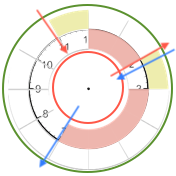
One particularly creative student, an artist, offered invaluable insights. Together, we devised a simple yet effective method using a familiar symbol: the clock face. We realized that most of us are so accustomed to reading the time, even in a groggy state, that it could serve as an intuitive tool for tracking sleep.
We implemented an inner dial to represent actual sleep time (approximately) and an outer portion to indicate periods of wakefulness. The artistic student found that adding colors to represent different phases of sleep greatly enhanced her understanding and engagement with the process.
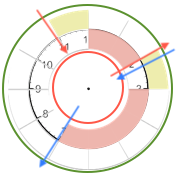
For example, on one night, she went to bed at 11 pm (indicated by a down-arrow) but didn’t fall asleep until midnight (depicted in green). She then slept until 2 am, when she briefly woke up (perhaps to use the bathroom) before returning to bed. After lying awake until 3 am, she finally drifted off to sleep again until 7 am, when she got up for the day.
She had thought that she had not slept well that night, that she had laid in bed “for hours” yet, she saw that she had a “pretty good” sleep from 3 to 7.
Despite feeling like she hadn’t slept well that night and had spent “hours” awake in bed, she discovered through the visual representation that she had actually enjoyed a solid block of sleep from 3 to 7 am.
This newfound awareness allowed her to recognize a consistent pattern of waking up around 2 am each night. Armed with this knowledge, she was able to approach her sleep routine with greater understanding and flexibility. She began planning meaningful yet relaxing activities for those early morning hours, such as knitting, and utilized the period before falling asleep to engage in calming practices like listening to self-help recordings, spiritual content, or gentle Feldenkrais lessons.
Within just a month, she experienced a remarkable transformation, embracing a newfound sense of vitality and purpose in her daily life.